


As part of the European Commission’s ISOS programme, this project aims to deploy advanced space robotics and in-orbit rendezvous to support sustainability in space by enabling satellites’ life extension and enhancement while reducing space debris.
ILA Berlin air show, June 10th 2026 - Thales Alenia Space, a joint venture between Thales (67%) and Leonardo (33%), and its partners have been chosen by the European Commission to lead the EROSS SC project dedicated to on-orbit servicing activities. This project is a key component of the European Commission’s ISOS (In-Space Operations and Services) programme, which aims to carry out a pilot mission by 2030, thus paving the way towards the development of a European infrastructure for in-space operations and services.
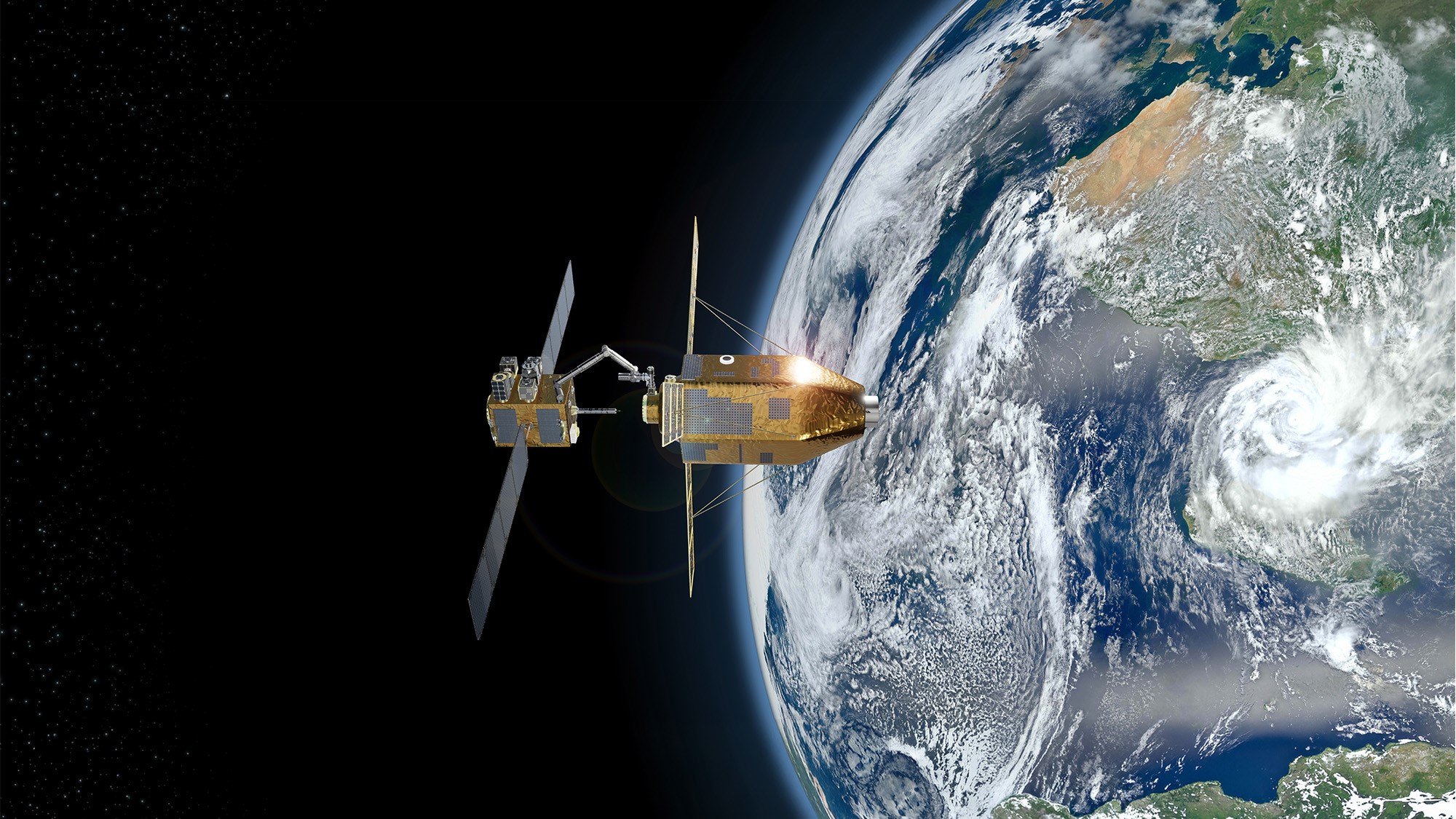
The EROSS SC (European Robotic Orbital Support Services – Servicing Component) contract, worth 12 million euros, calls for the development of one of the two spacecrafts capable of carrying out Europe’s first demonstration mission involving automated rendezvous and robotics operations directly in space. This mission, coordinated by Thales Alenia Space in France, will validate the technologies needed for future robotic in-space servicing operations, such as satellite rendezvous, capture, docking, refuelling and payload exchange capabilities. This spacecraft will then be integrated, along with the other components of the ISOS programme, into the pilot mission scheduled for 2030, and will carry out a pre-operational mission consisting in capturing an end-of-life satellite to perform a controlled atmospheric reentry, thereby preventing it from becoming space debris.
The other spacecraft, “SCOPE”, also capable of testing automated rendezvous and robotics operations directly in space, has been awarded to Leonardo and includes a participation of Thales Alenia Space in Italy.
With the growing number of satellites orbiting Earth[1] and the easier access to space to meet the growing global population’s needs, from geolocation to connectivity, through weather forecasting and environmental monitoring, Thales Alenia Space has been developing, for several years, smart On-Orbit Servicing missions to directly manage satellites while they are operating in space. The goal is to extend satellite lifetimes while also mitigating space debris to enable better management of current and future space assets.
This multifunctional spacecraft represents a real paradigm shift, since future space systems will be able to undergo maintenance and upgrades, even in orbit. By introducing unrivalled system scalability and flexibility, they will be a game changer. Satellites as we know can therefore be designed in a completely new way.
“We are honoured that the European Commission has entrusted Thales Alenia Space and its partners to participate in the ambitious ISOS programme aimed at demonstrating the European industry’s ability to develop on-orbit services,” stated Bertrand Denis, Vice President Observation, Science and Exploration at Thales Alenia Space in France. “The future of on-orbit operations missions in Europe is promising, as they will revolutionise the way we manage and maintain our space assets. These missions will not only enable satellite life extension in orbit but will also play a crucial role in mitigating space debris, ensuring a safer and more sustainable space environment for future generations.”
About the consortium:
EROSS SC will be led by a consortium coordinated by Thales Alenia Space in France, which will also supervise the overall system as well as the Guidance, Navigation, and Control (GNC) functions. The consortium includes: the Robotics and Mechatronics Center at the German Aerospace Center (DLR) and KINETIK Space (Germany) responsible for the robotic arm; Space Applications Services (Belgium) developing the tool-change mechanism for the robotic arm; Sener Aeroespacial (Spain) developing universal interfaces and refuelling systems; PIAP Space (Poland) providing the satellite gripping mechanism; SINTEF (Norway) contributing to the software architecture; Keyes (Belgium), Sener Aeroespacial (Spain), and Magellium Artal Group (France) developing vision algorithms for robotics and rendezvous operations for both prepared and unprepared satellites; Arribes Enlightment (Spain) leading the spacecraft’s life cycle analysis, while TIPIK (Belgium) is responsible for the project’s communication and dissemination.
Funded by the European Union. Views and opinions expressed are however those of the author(s) only and do not necessarily reflect those of the European Union. Neither the European Union nor the granting authority can be held responsible for them.
About Thales Alenia Space
Thales Alenia Space leverages a unique combination of skills, technological expertise, and industrial capabilities to deliver innovative solutions for telecommunications, navigation, Earth observation, defense, exploration, science, and orbital infrastructures— drawing on 50 years of proven experience. Institutions, governments, and private industry rely on Thales Alenia Space to design satellite-based systems that provide anytime, anywhere, connections and positioning, monitor our planet, enhance management of its resources, explore our Solar System, and unlock the mysteries of the Universe. Embodied by its Space for Life purpose, Thales Alenia Space sees space as a new horizon, helping build a better and more sustainable life on Earth, and beyond. A joint venture between Thales (67%) and Leonardo (33%), Thales Alenia Space also teams up with Telespazio to form the Space Alliance, which offers a complete range of solutions including services. Thales Alenia Space posted consolidated revenues of €2.36 billion in 2025 and has more than 8,000 employees in 7 countries with 14 sites in Europe. #spaceforlife www.thalesaleniaspace.com
[1] Debris by the numbers, source: ESA